Sequoia Surges, Channel Islands Slips: SoCal National Park Visitation in 2025


The National Park Service released its 2025 visitation figures against a tumultuous backdrop: the longest federal government shutdown in U.S. history cut into peak-season staffing system-wide, and overall national park attendance fell roughly 2.7 percent from 2024’s all-time record of 331.9 million visits. The twelve NPS units in and around Southern California for which data is available tell a more varied story, with some genuine bright spots buried under the aggregate decline.
Three units in the region, San Gabriel Mountains National Monument, Sand to Snow National Monument, and Chuckwalla National Monument, are managed by the Bureau of Land Management and U.S. Forest Service rather than the NPS, and do not appear in the NPS visitation dataset. Their visitor counts, where tracked at all, use different methodologies and are not directly comparable.
Sequoia and Kings Canyon: the strongest story of the year
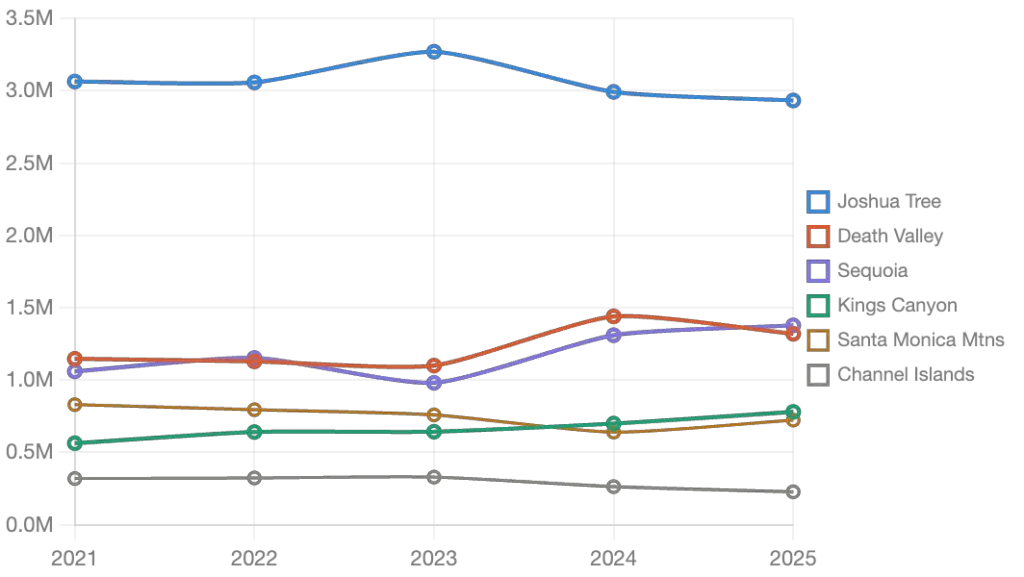
The Sierra Nevada parks were the region’s clearest winners in 2025. Sequoia National Park logged 1.378 million visitors, up 5.3 percent from 2024 and 30 percent above its five-year average. Kings Canyon, administered together with Sequoia but tracked separately, grew even faster — up 11.5 percent to 779,791 visits, and 31.7 percent above its five-year average. Both parks have been on a sustained upward trajectory since 2021 and appear to be capturing visitors who might otherwise head to more crowded destinations.
Year-over-year change 2025 vs 2024 — NPS units with data (%)

Death Valley draws a once-in-a-decade crowd — then the heat arrives
Death Valley National Park recorded 1.32 million visitors in 2025, down 8.4 percent from 2024’s record-setting 1.44 million but still the second-highest total in the park’s history. The year opened with a rare superbloom, the first at this scale since 2016, triggered by record November rainfall — that drew significant national attention. That surge was then cut short by a historic March heat wave, which drove temperatures to 107 degrees Fahrenheit and ended the bloom weeks ahead of schedule. Against the five-year average of 1.13 million visits from 2020 to 2024, 2025 remains up 17 percent — the one-year dip notwithstanding.
Santa Monica Mountains rebounds, Mojave recovers
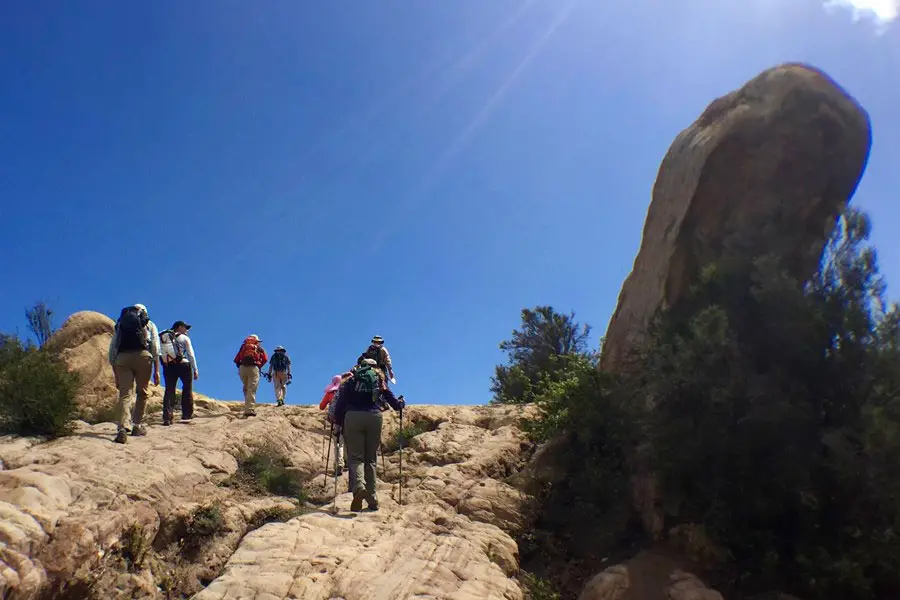
Santa Monica Mountains National Recreation Area, anchored by the Backbone Trail, climbed 13 percent over 2024, reaching 722,626 visits and partially reversing three consecutive years of declining attendance. The proximity of the recreation area to communities devastated by the January 2025 Palisades Fire complicated early-year access, making the rebound more notable.
Mojave National Preserve posted the region’s biggest year-over-year percentage gain at plus-34 percent, reaching 569,844 visitors. That number needs context: the preserve’s 2024 count of 424,864 has been questioned due to methodology issues around through-traffic on its roads, and the Kelso Depot visitor center remains temporarily closed. Against the five-year average, Mojave is still down 26 percent — a figure that reflects years of fire damage, chronic underfunding, and infrastructure strain.
Five-year trend 2021–2025 — selected major units (millions of visits)
Joshua Tree plateaus near 3 million

Joshua Tree National Park, the region’s most-visited unit, recorded 2.93 million visitors, down 2 percent from 2024 and essentially flat against its five-year average of 2.96 million. The park has hovered in this range since 2021, suggesting it has reached a natural ceiling constrained by infrastructure, access roads, and the limits of its remote location.
Channel Islands continues a quiet slide
Channel Islands National Park is the data point most deserving of a closer look. At 227,186 visitors in 2025 — down 13.5 percent from 2024 and nearly 19 percent below its five-year average — the park’s sustained erosion reflects structural challenges rather than any single event. Getting to the islands requires a ferry from Ventura or Oxnard, with service to some islands running as infrequently as four times a month, and limited primitive camping demands planning that casual visitors typically bypass. There is no road access and no on-island lodging. Nothing in the 2025 figures suggests the trend is reversing.
National Parks and Monument Visitation in 2025
| Unit | 2024 visits | 2025 visits | YoY | vs 5yr avg |
|---|---|---|---|---|
| Joshua Tree NP | 2,991,874 | 2,932,644 | −2.0% | −0.8% |
| Death Valley NP | 1,440,484 | 1,320,134 | −8.4% | +17.1% |
| Sequoia NP | 1,309,573 | 1,378,337 | +5.3% | +30.1% |
| Cabrillo NM | 845,912 | 769,336 | −9.1% | +5.9% |
| Kings Canyon NP | 699,389 | 779,791 | +11.5% | +31.7% |
| Santa Monica Mountains NRA | 639,745 | 722,626 | +13.0% | −3.9% |
| Mojave National Preserve | 424,864 | 569,844 | +34.1% | −26.0% |
| Pinnacles NP | 354,076 | 343,208 | −3.1% | +15.6% |
| Channel Islands NP | 262,581 | 227,186 | −13.5% | −18.9% |
| Devils Postpile NM | 94,215 | 99,652 | +5.8% | −13.9% |
| Manzanar NHS | 93,854 | 95,764 | +2.0% | −4.0% |
| César E. Chávez NM under review | 26,641 | 31,497 | +18.2% | +142% |
| San Gabriel Mountains NM no NPS data | — | — | — | — |
| Sand to Snow NM no NPS data | — | — | — | — |
| Chuckwalla NM designation contested | — | — | — | — |
A monument’s uncertain future — and an even more uncertain one
César E. Chávez National Monument posted an 18 percent gain to 31,497 visitors, extending a steep growth curve from just 9,164 in 2021. Those numbers now carry a significant asterisk.
In March 2026, a New York Times investigation published allegations that Chávez sexually abused girls and women over decades — including UFW co-founder Dolores Huerta, who came forward publicly for the first time. The fallout was swift. The United Farm Workers canceled its annual tribute events; the California Museum announced it would remove Chávez from its Hall of Fame; and cities and school districts across California, Texas, and Arizona began removing statues and renaming public spaces. According to Wikipedia’s account of the monument, some of the alleged abuse took place at La Paz itself. Altering or renaming a national monument requires either an act of Congress or presidential action. Neither has been announced, but the institution’s identity is now inseparable from an active public reckoning.
Chuckwalla National Monument — which is not in the NPS dataset and had no reportable visitor figures in 2025, having been designated just weeks before the year began — faces a different kind of challenge. President Biden established the 624,000-acre monument in the final days of his term, protecting desert lands bordering Joshua Tree that are sacred to multiple tribal nations. The Trump administration subsequently directed the Interior Department to review the designation, and in May 2025 a Michigan miner and an Idaho off-road vehicle group filed suit to dissolve it entirely, arguing the Antiquities Act was never intended for monuments of this scale.
A federal court in March 2026 allowed five tribal nations and nine environmental organizations to intervene in the case — a significant procedural win for defenders, but the lawsuit itself remains unresolved. Interior Secretary Doug Burgum has publicly suggested the monument may simply be too large. The outcome of the case could set precedent for how future presidents use the Antiquities Act, and for whether Chuckwalla remains protected at all.
The broader picture
The SoCal results largely mirror what GearJunkie found in its analysis of 2025 NPS data system-wide: parks with specific compelling draws held their own or grew, while those dependent on consistent baseline access — or managing accumulated infrastructure deficits — showed the most strain. Sequoia and Kings Canyon are a genuine success story. Channel Islands is a slow-motion concern. And two monuments, for very different reasons, will spend 2026 uncertain of what they are.