Plan to run a massive powerline through Anza-Borrego gets pushback

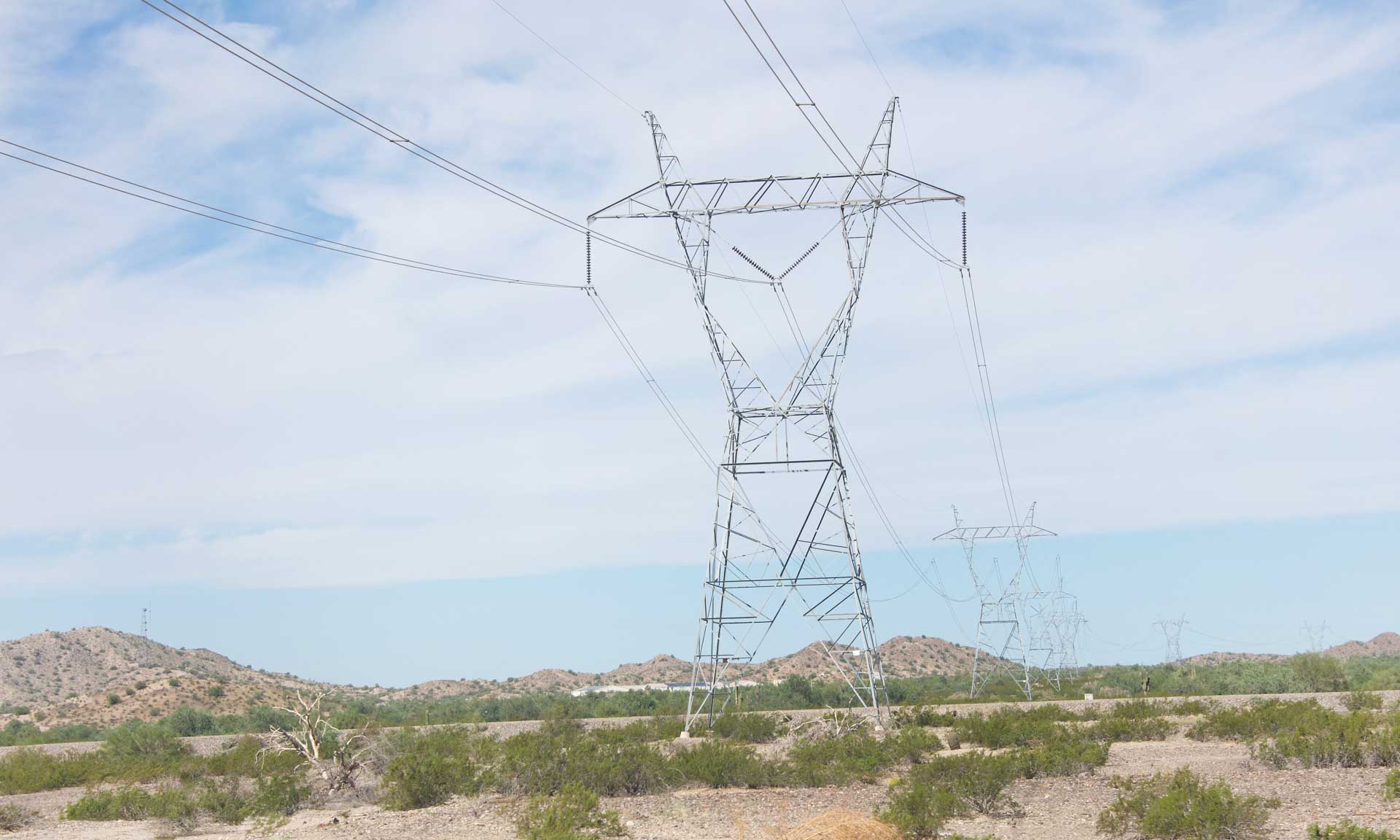
A San Diego Gas & Electric plan to route a major new transmission line through the heart of Anza-Borrego Desert State Park is drawing fast opposition from conservation groups, tribal governments, and elected officials across three counties, with the Anza-Borrego Foundation leading a public campaign to stop the line before it reaches formal regulatory review.
The strongest argument against the route is one regulators have already made: the corridor SDG&E proposes through the park appears to be substantially the same one the California Public Utilities Commission rejected in 2008 during the Sunrise Powerlink review.
That earlier decision, D.08-12-058, identified 52 significant, unmitigable environmental impacts along the Anza-Borrego alignment and determined all park-crossing routes were “environmentally unacceptable and infeasible.” Sunrise was rerouted south of the park.
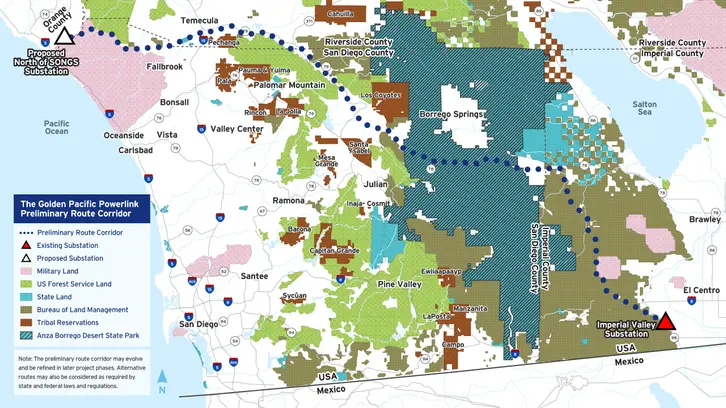
The 22-plus miles inside Anza-Borrego that CPUC found infeasible 18 years ago track closely with the corridor SDG&E now proposes for the Golden Pacific Powerlink, a 500-kilovolt, roughly 135-to-145-mile line running from the Imperial Valley Substation to a new substation near the decommissioned San Onofre Nuclear Generating Station.
The link would cross U.S. Forest Service land and continue northwest through Warner Springs, Palomar, Pala, Pauma, Valley Center, and Temecula. Towers would stand 150 to 200 feet tall. CAISO has projected the project at roughly $2.3 billion.
Behind the proposal is a real demand problem. The California Independent System Operator’s 2022-2023 transmission plan calls for more than 40 gigawatts of new generating resources over the next decade to meet rising load, much of it driven by expected data center growth tied to AI and by the state’s 2045 mandate to decarbonize the grid, buildings, and transportation.
CAISO selected Golden Pacific as one of 45 transmission projects needed to move that generation from where it’s produced to where it’s used. SDG&E’s Erica Martin has called the line one of the “energy freeways” the buildout requires and argues Anza-Borrego is too large for the route to feasibly avoid.
On both pieces of that case, critics push back. Bill Powers of the Protect Our Communities Foundation told the San Diego Union-Tribune that SDG&E could roughly double the capacity of existing lines by reconductoring with advanced composite materials and replacing single-circuit towers with double-circuit ones.
He puts rooftop and parking-lot solar potential across the SDG&E service area at three times what’s currently installed. CPUC awards SDG&E a 9.88 percent return on equity for approved infrastructure projects, a structural incentive to build new lines rather than upgrade existing ones.
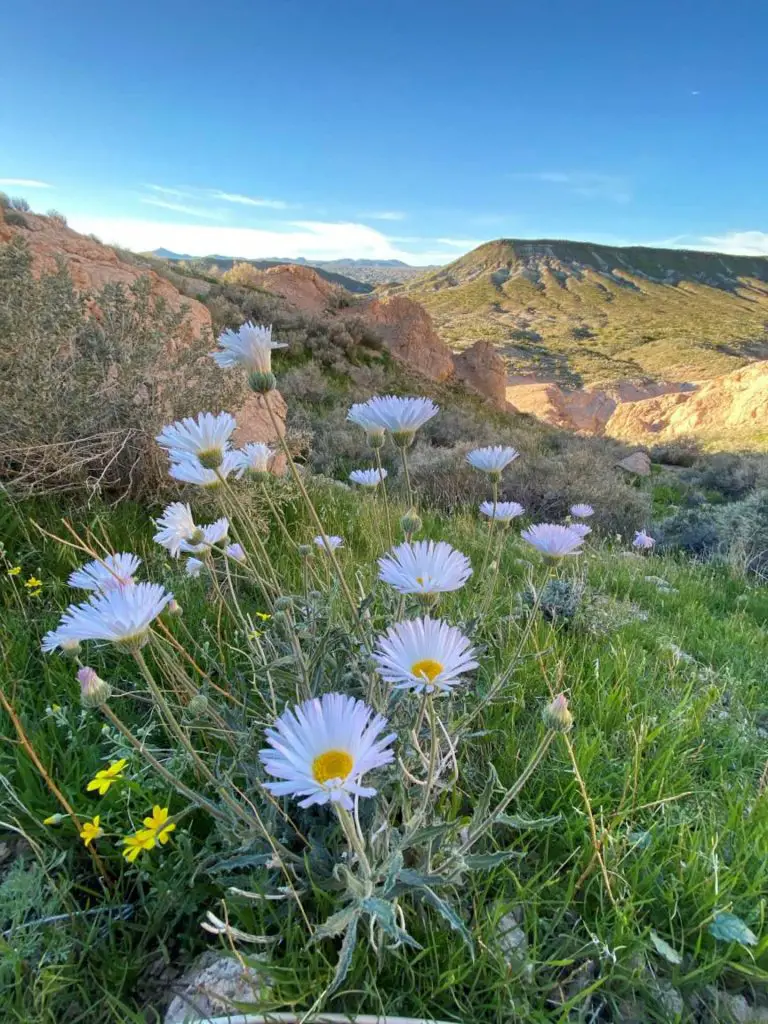
What has also changed since 2008 is the ecology of the desert itself, and the change is in the wrong direction. A UC Irvine study in the Journal of Geophysical Research: Biogeosciences documented a nearly 40 percent decline in native vegetation across the Colorado Desert since the 1980s.
ABF’s long-term photo monitoring shows steep losses of ocotillo, teddy-bear cholla, and desert fan palm inside the park, and the endangered Peninsular bighorn sheep are increasingly dependent on emergency water drops in dry years.
Beyond the park, local elected officials and tribal governments along the corridor are also pushing back. Temecula City Councilmember Brenden Kalfus, a former firefighter, opposed the project last week and pointed to the route’s location in a high-severity wildfire zone.
Pechanga Tribal Chairman Mark Macarro issued a statement raising concerns about impacts to ancestral cultural resources and calling for meaningful consultation. A resident petition launched in Temecula over the weekend cleared 1,200 signatures within days.
ABF has flagged a separate inconsistency in SDG&E’s own public materials. The utility’s August 2025 press release described the project as essential to California’s carbon reduction goals, but the April 2026 public fact sheet drops the clean-energy framing and describes the line in source-neutral terms. No binding requirement in the project’s public documentation commits the line to carrying renewable energy.
SDG&E plans to file its formal CPUC application later this year. Stakeholder feedback is open through early November 2026 at GoldenPacific@sdge.com. The full CEQA and NEPA review is expected to run through fall 2029, with construction targeted for that year and service projected for 2032.
SDG&E is hosting two virtual open houses tomorrow, May 14, 2026, at 12:00 p.m. and 5:30 p.m, which will each present the same information. Visit www.sdge.com/GoldenPacific to register or learn more.